Home
Up
Airbus Nosegear
Autoland Crash
Autoland Crash2
Nose Gear Incident

Contact us!

Alexis Park Inn & Suites
  1165 S. Riverside Drive
   Iowa City, Iowa  52246
Toll Free: 888-9ALEXIS

(888-925-3947)

Local:  319 337-8665
Fax:    319 351-4102
Email:AlexisParkInn@mchsi.com

Proud Members of:


Iowa Bed & Breakfast Guild


Iowa City Chamber of Commerce


Iowa City Convention & Visitor's Bureau


AIRLINERS

This page was last updated on 01/02/2010


Despite commercial aviation's incredible safety record, the greatest fear of every airline passenger is an in-flight incident.   Some of these videos capture that "moment of truth" when bad things happen during a routine flight.

 
24 Hour World Airline Ops   Contributed by Paul Rawnsley.  The video is a 24 hour piece, showing worldwide airline operations, compacted into 2 minutes.  The yellow points are commercial airplanes, some of them with more than 300 people on board. Note that the flights from America eastbound towards Europe are during the night while from Europe to America are during the day time.
 
707 Flying -- The Way Things Were    This Pan Am promotional video from 1958 is almost painful to watch, for those of us who remember how wonderful airline travel used to be.  For those too young to recall, the level of service shown in this video will look more like science fiction than fact -- but trust us, it really used to be this way!
 
727 Demolition    Heart-breaking time-lapse video of a grand old Boeing 727 being scrapped.  Contributed by Paul Rawnsley.

Updated info from Jim Prost:

"The video is actually a Boeing 720B, the airplane was used for the last 15 years as a Flying Test Bed (FTB) for the Honeywell International. Aircraft Engine Division, Engineering department for research of proposed new designs and certification of new engine models. I worked on the B720 as a Project Test Engineer which help certify Honeywell's new engine HTF 7000. I owned the engine under test. If one looks carefully at the aircraft just before destruction, there is a mount on the right side of the airplane that was the engine under test mount."

Jim Prost, Defense & Space Engineer, Senior

 
737 Crash Landing  Incident is a Boeing 737 landing at Birmingham, UK with the right landing gear missing, after tearing off the starboard gear when attempting to land at East Midlands Airport in bad weather.   The pilot missed the runway and landed in the grass, doing extensive damage to the aircraft.  He was able to fly some 40 miles to Birmingham, where the incident was caught on video by the West Midlands Police helicopter.

Click here to view the Air Accident Investigation Board's official report.   Click here to view the BBC report of this incident.  Click here to see pix of the plane after it landed.

 
737 Engine Fire   A post-maintenance engine test shows that they mechanics haven't quite found the problem yet!

Additional info from a spotter:

"In the Video 737 Engine Fire there is nothing wrong with the engine.  When you install an engine that has been has been in storage 'preserved' it has a lot of preservative in the fuel control system. (fuel control, fuel pump, etc.)  That is what you see burning. It is very spectacular to watch, and any time we would install a 'preserved' engine we would have a crowd to watch the show. As you can see in the short video the engine is not shut down when the flames appear, as would happen if something were really wrong."

737 Farewell Fly-By  A final fly-by in Calgary, Alberta as West Jet retires their last Boeing 737-200.
 737 Gear Up Landing Wouldn't want to be on *that* flight!
747 Flight Demo   The pilot of this South African air lines 747 puts on a beautiful flight demonstration.  It's hard to believe anything so big could look so graceful!
747 Landing   This beautiful video was contributed by Robert Lane, of Lumenosity, LLC 2006.  This video is copyrighted to Lumenosity, LLC 2006.
747 Off the Runway!   Security camera footage of a Tradewinds 747 running off the end of a runway on 6/6/06. 
747 Retirement Flight   Watch as this pilot shows consummate skill planting the big Boeing onto a very narrow, very short runway, for display in an aviation museum.
747 Water Bomber   Got a big fire to put out?   You *need* this plane!
757 Fly-By  This video,  taken on Friday, 2/10/06, is of an Iceland Air 757 showing off a brand new set of winglets just installed by Kelowna Flightcraft, based in Kelowna, British Columbia, Canada.
757 Radical Departure  This 757-200 has been fitted with Rolls-Royce engines, which clearly develop an impressive amount of power.  Filmed by Erin Johnson.

Additional Info, from Andrew Burfield:

"This Boeing 757-200 of No.40 Squadron, Royal New Zealand Air Force, is performing a 350 knot pass at 100 ft, before displaying the 757’s awesome power-to-weight ratio with a 45 degree climb out to 7,500ft. The video was taken at RNZAF Base Whenuapai, Auckland, New Zealand, probably at the 2004 Air Force Open Day."

Additional Info from Erin Johnson -- the videographer who filmed the departure:

"Basically, what has been written is correct regarding the height, speed and climbout angle, however it wasn't at an airshow.  It was a private function for past and present members of 40 Squadron RNZAF and at the end of the day there was a small flying display by the 757 and a C130 Hercules. 40 Sqn operate both types of aircraft. For your info: The RNZAF purchased their two 757's from Transavia and we started flying them as soon as they were re-painted and delivered. No modifictions were done to them, so in effect, this display is from a standard 757-200 with RR RB211 engines fitted. Both 757's are now at Mobile, Alabama having some extensive mods done to them - including the fitting of a large cargo door in the front left side, strengthening the forward section floor for loading of freight pallets, fitting of airstairs which operate from the rear entry door (these are really long as the tail end is a long way off the ground) and the fitting of a crew entry ladder."

"The large upwards opening cargo door is a huge job. Normally when 757's get converted to cargo planes, that's all they can carry is the emergency oxygen system, reading lights, air ducts and everything else in the overhead panels are removed in total. In our Mod, we're getting a combi fit. This means there are numerous combinations available to use: part cargo, part passenger in various layouts or a full passenger fit. This means that the overhead panels need to remain - even on the door. So it'll be interesting to see how everything has been wired and plumbed. I had heard talk of getting the engines uprated but can't confirm if this is happening. The first aircraft was recently finished and is now entering the flight test evalution phase of the project once some smaller niggles have been rectified."

"We're looking forward to getting our two jets backs. They're the only ones our Airforce has !!"   Regards, Erin.

757 Short-Field Departure    This video, shot in Reykavik, Iceland, shows an impossibly short-field take-off performed by a Boeing 757, followed by some nice high-speed passes.
777 Engine Change A neat video compilation of the steps involved with changing a huge jet engine on one of the world's largest airliners.
777 Time-Lapse    This amazing video shows the construction so a Boeing 777 airliner from start to finish in time-lapse photography.  VERY cool!
A Day In The Life of An Airport  Well, not an entire day -- but this is amazing time-lapse photography of a busy international airport, centered on loading a 747.
Air Tindi Flyby  Taken in Yellowknife, Northwest Territories, Canada, this video shows a Dash 7 doing a low-level fly-by.  The slow frame rate of this video makes it look like all four props are stopped!
 
Afghan Airbus A-300 Nosegear Failure   Home video of yet another in a long series of Airbus nosegear extension failures.  Here's the story, from contributor Peter Metz: 

"This shows FG flight 709, bound from Kabul to Dubai, which left the Kabul Airport with 261 passengers on board.  After departure the pilot had a problem with the front wheel gear and could not retract it.  Instead of proceeding to Dubai Airport (flight time 2:30 minutes), with all relevant security measures he decided to land back at Kabul Airport."

"Capt. Abdul Rahman asked the tower to investigate the problem.  Kabul Airport sent an ICRC plane to investigate the problem from beneath the aircraft.  After the problem was located, the captain released most of all the full tanks of kerosene and made a final approach at Kabul Airport.  At this time there were still about 30,000 mines lying around beside the apron."

"After the plane came off the runway nothing happened, and the fire brigades went to rescue the aircraft and passengers. The plane came to stand about 50 meters beside the runway without any problems.  All passengers escaped the aircraft safely. Capt. Rahman got out of the plane, had a cigarette smoke, and took all the passengers to Dubai in a second plane approximately an hour later.   ISAF than pulled the plane from beside the apron, stretched the wheel straight, and pulled it to the maintenance department."  

Afghan Airbus A-300 Nosegear Failure Photo Compilation 

Contributed by Jeldo Metz.  This is a compilation of still photos taken of the landing of the Afghan Airbus A-300, above, by Jeldo's father, Peter Metz.  Jeldo has sequenced the still photos and set them to music.  To see other videos by Jeldo, go to:  http://www.youtube.com/user/outofpower

Airbus A-320 Radical Departure Nothing like a 60-degree climb-out to keep unruly passengers in their seats...
Airbus A-321 Extreme Crosswind  An aborted landing nearly goes terribly wrong in a howling crosswind.

Airbus A-380 Crosswind Certification    Watch as the biggest airliner in the world lands in some extreme crosswinds!  (This video is from Iceland.  Anyone care to take a whack at translating the narration into English for us?) 

A Translation, Contributed by Hordur Ingolfsson:

"Hi, saw you wanted translation of the narrative of the A380 video shot in Iceland. This video was shot at Keflavik international airport during “practice” landings.

Here goes the translation:

“Not every day we see the biggest passenger airplane in the world land in Iceland, bla bla bla, but today the Airbus 380 was practicing crosswind test landings at Keflavik Airport. Test conditions were 'ideal', with a steady wind blowing 35 to 45 knots.  After only a short stop, the aircraft went up again for repeated approach and test landings that all ended happily. It was amazing to see how this big aircraft handled took on the elements and such strong wind, weighing at about 5 times more than B757 common in Keflavik airport, or 560.000 kilos.  The A380 can take up to 500-600 passengers, bla bla bla.”

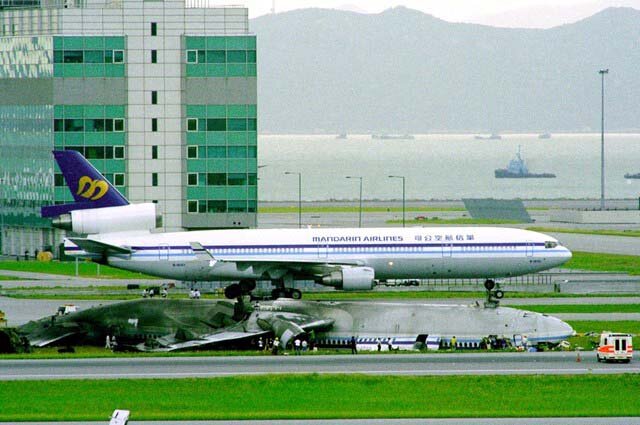
Airliner Crash  Home video of an airliner landing in a storm -- with disastrous results.

Additional information about this crash, sent in by a viewer:

22 August 1999; China Airlines MD11; Hong Kong, China: This aircraft was landing in Hong Kong at night and during a storm after a flight from Bangkok. The aircraft struck the runway and came to rest upside down and on fire. All 15 crew members survived, but three of the 300 passengers were killed.

Click here to see a picture of the aftermath of this crash.

Airliner Race!  This fantastic, hilarious, award-winning video is all digital.   The dialogue is all in German, but that hardly seems to matter....
Air MidWest Flight 5481 Crash   NTSB animation of the departure crash of a Beech 1900 in Charlotte, N.C. on January 8, 2003.
American Flight 587 Crash    NTSB animation of this mystifying rudder failure accident over New York.
American Flight 587 Toll-Booth Camera  Toll booth camera footage showing the crash of American Flight 587.
American Flight 1420 Animation   Contributed by Patrick Parks. From the FAA: This animation shows the last minute of flight for American Airlines Flight 1420, which crashed while landing at Little Rock, Arkansas on June 1, 1999. The reconstruction uses data retrieved from the Digital Flight Data Recorder and excerpts from the Cockpit Voice Recorder transcript.

The animation starts with the airplane at a barometric altitude of 664 feet, an airspeed of 154 knots, a Localizer beam deviation of 0.4 DOTS to the right and 0.6 DOTS above the Glide Slope. The animation shows the airplane touching down to the right of the runway centerline and continuing to track to the right nearly reaching the right edge of the runway before changing direction to left.

The remaining landing roll shows the airplane passing through the runway centerline and eventually departing the left edge of the runway just before reaching the end of the runway. The instruments displayed represent the following (from upper right to lower left): Airspeed, Altitude, Artificial Horizon, Heading with Localizer and Glideslope Deviation, Rudder Position, Right inboard spoiler position, Derived control wheel position, Left outboard spoiler position, Thrust reverser position (unlocked or deployed), and Engine Pressure Ratio.

Bad Landing  Okay, I *know* this is fake -- but so many of you guys keep sending it to me, I'm posting it here just to save you from sending it again!
Bad Landing II    I'll bet Alitalia air lines *wishes* this landing was faked -- but it looks real to us. Contributed by James Axelrad.
BAE-146 Bad Landing in London   This amazing video was contributed by Geno Becker:  "For those who want to fly to London City Airport, a cross wind adds to the excitement (in addition to the short runway and steep approach). The airport itself is located on the river Thames in downtown London, and gives business people very quick access to the city. The Millennium Dome is in the left side of the picture."

"The runway is only 1199 meters long, which is very short in airline runway terms, thus it is only suitable for aircraft with good STOL (short take-off and landing) performance. It also has a 5.5 degree glide slope, as opposed to the conventional 3 degree slope to most runways. The BAE 146 is the main jet type to operate into the place. Most other aircraft are turbo props etc."

"When doing the approach you have to be fully configured, i.e., gear down, full flaps and speed brakes before you commence descent from 3000 feet...or you won't get stopped before reaching the far end of the runway. If it doesn't look or feel right it is generally a good idea to give it away and have another attempt. For whatever reason, this flight crew decided to press, but they DID make the first turn off the runway. If nothing else, it's a testament to the toughness of the BAE 146 airframe. The pilots handled it like a dirtbike!"

Additional Info Contributed by John Forster:

"I would just like to update the wording on this video clip. Everything is dead right apart from the runway length, which is 1,508 m with a Landing Distance Available ( LDA) of 1,319 m, still quite short. There is also a two pairs of high intensity lights placed either side of the runway at 336 m from the touchdown point. These mark the end of the touchdown zone and a missed approach is required if the aircraft is not down by these lights. I work at LCY and was watching this landing."

Blade Out Engine Test   This video is of a ground test, showing what happens when a blade departs a spinning jet engine.  Ugly, indeed.  (Anyone know where/when this was filmed?)

New Info 10/2/09 from Paul Kerrison:

"Your video “Blade Out Engine Test” shows a Rolls-Royce Trent engine undergoing a blade off test for certification purposes. You can tell it’s a RR engine as the blades turn anti-clockwise (from the rear, GE and Pratt engines turn the opposite way)."

"A small explosive charge is placed at the root of the blade and detonated when the engine is at full power. The fan case has to contain the blade and any resulting debris to pass the test: A released fan blade contains enough energy to throw a medium sized family car 100 feet into the air. It’s hard to see which engine this is as the video is so small, but it looks like the Trent 800 (Boeing 777)  The T800 was the last of the engines to have white open wire harnesses in the area of the left side of the fan case you can see in the video."

"There are normally numerous camera angle on these test, a sideways on shot would make confirmation easier. All of Rolls-Royce fan blade off checks were, until recently, carried out at Hucknall Aerodrome near Nottingham. Environmental considerations (urban sprawl means noise complaints) have meant the end of testing outside at Hucknall and Rolls-Royce has invested in a new test bed at Derby and a testing facility at Stennis Space Center, Mississippi. If this is a T800 then certification was obtained in Jan 1995 so the video will probably date from 1994."

"FYI.  After a 16 year Royal Air Force career I started work for Rolls-Royce in 1997.  I now work in the new engine assembly plant at Rolls-Royce Derby as a training co-ordinator. We currently build Trent 500, 700, 800, 900 & 1000."

Boeing 767 Accident  A TACA 767 comes to grief after landing hot and long on a rain-soaked runway.  Filmed from INSIDE the plane...
New 1/2/2010   Category III Instrument Landing  You've got to have faith! Contributed by Phil Caiger-Watson.  Here's the story:
YOU GOTTA HAVE FAITH!!!
This is a Category 3 ILS (Instrument Landing System) landing. We  
refer to them as Cat 3, Land 3 Approaches. The horizontal visibility  
is 200 metres (600feet).
The aircraft is flown by three (3) autopilots on to the runway. The  
autopilots continues to keep the aircraft on the centre-line of the  
runway. The auto brake system stops the aircraft. The pilots monitor  
the performance of the autopilots and must be prepared to execute a  
missed approach if any of the required systems fail. The Missed  
Approach is accomplished by pressing a switch on the throttles.  
Again, the autopilot will fly the missed approach. The pilots must be  
ready to takeover and manually flying the missed approach if the  
autopilots fail.
You can hear the pilots making altitude call-outs and the response is  
"Land 3". This is confirmation (displayed on both pilots CRT's) that  
all the automatic systems are in agreement and that it is safe to  
continue the approach. You can also hear the auto call-outs made by  
the aircraft at 100 feet, 50 feet and 30 feet. The last call-out you  
hear is the First Officer advising that the speed-brakes have  
extended. Speed-brakes are the panel on the upper surface of the wings  
which extend vertically. Their purpose is to destroy the lift created  
by the wings and put the aircraft weight on the tires to improve  
braking.
China Air Fire  In what is surely the slowest response to an airliner fire every video-taped at a major airport, watch in horror as an airliner is nearly consumed by fire while parked at the gate before firefighters respond.   Contributed by Jeff Miller
Concorde's First Flight  It's hard to believe that this lovely and advanced aircraft no longer graces the skies.  Re-live 1969, when men landed on the moon and we thought we could do *anything*.  Submitted by Roy Meister
Concorde's First Flights  With BBC commentary and an interview with pilot Brian Trubshaw.  Submitted by Roy Meister.
Constellation 1953 -- Part I    This fascinating (but immense -- it's a huge download) video offers a window into the airline world, circa 1953.  It was filmed with TV and radio personality Arthur Godfrey acting as "tour guide" flying an Eastern Air Lines Lockheed Constellation, and features World War I ace (and Eastern Air Lines president) Eddie Rickenbacker flying a Spad.  (And check out the meals the passengers are being served!)

(Note: This video plays best if you right-click and download it to your own computer -- then play it using RealPlayer.)

Constellation 1953 -- Part II    This fascinating (but immense -- it's a huge download) video offers a window into the airline world, circa 1953. Filmed with TV and radio personality Arthur Godfrey acting as "tour guide" flying an Eastern Air Lines Lockheed Constellation, it features flying an ILS (Instrument Landing System) approach, a GCA (Ground Control Approach), breaking the sound barrier in a Lockheed F-94 Starfire (piloted by none other than Tony Levier), and Eastern Air Lines president Eddie Rickenbacker talking about the coming "helicopter feeder lines" that will make getting to the airport simple!

(Note: This video plays best if you right-click and download it to your own computer -- then play it using RealPlayer.)

Constellation -- 1990    This video shows the graceful "Save-A-Connie" Super Constellation coming in to land at an airshow in Oklahoma City on Father's Day, 1990.  Filmed and contributed by JB Duncan.
Crash Compilation   This is a slide show of (mostly airline) crashes over the years, set to music.  Quite interesting. Contributed by Max Barz.
Cross Wind Landings!  This video shows certification tests for various Boeing airliners.  With Portuguese subtitles.

Translation of the Portuguese sub-titles graciously provided by Carolina Penteado:

"Its not all days…

That we find calm winds…

What to do in these situations?  Fly…

Go back to the “aero-club” time…

Remind yourself of your instructors…

And land safely…

These pilots certainly flew conventional aircrafts.. Learn with the best!"

Cross Wind Landings 2   With many thanks to video editor Jon Salmon, this is the same video as "Cross Wind Landings!" but without the subtitles, and with new (and vastly improved!) background music added. 
Cross Wind Landings 3  Okay, so we've created a little cottage industry here!   With many thanks to video editor Steve Lyons, this is the same video as "Cross Wind Landings!" (above), but without the subtitles and with the ORIGINAL background music (which many of you like better than "Top Gun", apparently...).

Many viewers have expressed interest in the unique music on this video.  Here is new information, provided by Charlie Hanna:

"The background song with the 'Cross Wind Landings' video is "Return To Innocence" by Enigma, it came out sometime in 2001. I got lucky and stumbled onto it, I love that song."

Info about this music, from Michael McEuen:

"I'm one of the many that love these extraordinary videos, (Cross Wind Landings). I'm also a really big fan of this site. You have went to great lengths to provide a real cool site of aviation videos both good and bad. I noted a update by Charlie Hanna about the music "Return to Innocence." With all due respect to the help Mr. Hanna is trying to offer, he is wrong about the release date of 2001. I do believe his date was referring to the movie "Return to Innocence", which was released in 2001.  It can also be found on the very first "Pure Moods" CD dated 1994. It can be viewed @ http://en.wikipedia.org/wiki/Return_to_Innocence "

Crosswind Landings 4   Another great compilation of crosswind landings, with some new ones thrown in.
DC-3 on a Grass Strip   This video shows a Douglas DC-3 painted in Piedmont Airlines livery landing on the grass at Ferrell's Fly-In on Lake Norman.  Contributed by Ken Roberts (and others).

Added Info from Eric Schmidt, of the Carolinas Aviation Museum, Charlotte, NC:

"I love that video of a DC-3 on a grass strip.  I recognized it right away.  It was built in '42 as a C-47 and sold right after the war as surplus.  It stayed with several companies and then, in the late '70s, was bought by Piedmont Airlines, who had it converted to a DC-3, as seen on the video.  They used it for PR, incentive flights and employee excursions.  Piedmont wanted a DC-3 since that's what they started the airline with.  When US Airways bought them out, of course they didn't want it and put it on the market.  Thanks to the generosity of many people we bought it and still fly it to air shows as shown."

DC-3 Radical Departure   If this is legit, is looks like the DC-3 sends the cameraman sprawling!   Anyone know what's happening here?
Ditching At Sea  A hijacked airliner runs out of gas and is caught on video.
Extreme Landing!  A Boeing 747 doing things no one ever envisioned...
FedEx 24 Hour Ops   This amazing video shows the radar track of every FedEx flight in America over a 24 hour period.  Remarkable!

New Info 6/9/09:

I've received word that this version of "Going to California" is from and album entitled "Pickin' On Led Zeppelin", which can be obtained at www.Amazon.com 

FedEx Diversions   This remarkable video graphically shows the radar track of hundreds of planes that were forced to divert around intense thunderstorms in the Memphis area.
FedEx Flight 647   This NTSB animation shows details of the crash of FedEx Flight 647 on December 18, 2003 in Memphis, Tennessee.
FedEx Flight 647 Evacuation   Amateur video showing the crew shinnying down the escape rope as the plane burns, following the landing accident on December 18, 2003.
FedEx Flight 1478    A highly detailed NTSB animation of a landing crash that occurred July 26, 2002, in Tallahassee, Florida.
GE's Biggest Engine Yet   Contributed by Rodney Luck, this video shows the largest jet engine in the world being tested.
Hudson River Flight 1549 Ditching    This is a re-creation of the US Airways Flight 1549 that made an emergency landing in the Hudson River after losing both engines after a bird strike on January 15, 2009.  It depicts the aircraft as Captain "Sully" Sullenberger flew from takeoff to touchdown, with actual ATC radio transmissions.  This gives you some perspective of how quickly the US Air flight crew had to react to realize the amazing outcome they achieved. Contributed by Antonio More.
 
New 1/2/2010  Hudson River Flight 1549 Depiction This shows the flight path taken by US Airways Flight 1549 after hitting the birds, ultimately resulting in a water ditching in the Hudson River.  Caution: This is a very large, 98 MB download. Contributed by Steve Young.
 
New 1/2/2010  Hudson River Flight 1549 Radar Time Lapse This shows a different time-lapse depiction of the flight path taken by Flight 1549 after hitting the birds, with actual radar returns of all the flights in the area.  Contributed by Steve Young.
 
Ilyushin-76 Using It All    Airliners usually use no more than 2/3rds of the runway to take off.  Watch in amazement as this fully-loaded Russian cargo jet takes off on a hot, calm Australian day -- and uses every last inch of runway!

Additional Info From Michelle Robertson:

"The video 'Illushin Using It All' was taken from the control tower at Canberra Airport (in Australia) -- which from memory is 1888 feet MSL.  Interestingly, they have now extended the end of the runway that the plane is taking off towards by another 400 meters I believe.  To allow even take-offs with a 5 hour fuel load on a 100 degree day!"

Landing Gear Trouble  On 9/22/05, a JetBlue Airbus pilot couldn't get his nose gear to rotate into landing position.  This video of the safe and successful landing at Los Angeles International airport shows the best possible outcome to every passenger's worst nightmare.

Click here to view several remarkable, high-res photos of the aftermath of this and another VERY similar landing.  Although Airbus may not make the most reliable nose-gear system in the world, it's certainly TOUGH.

Click here to read expert commentary on this unusual problem.

LAX Runway 24 Close Call    Watch and listen to an NTSB animation that reconstructs a 747 that is cleared to land on Rwy 24 -- the same runway that another jet liner is about to depart from!

Additional Comments from Tim Laity:

"I was once an air traffic controller and this video attributed a mistake made by the air traffic controller that in fact was never made.  According to the narrative included with the video, the departing aircraft is cleared for takeoff at the same time another inbound aircraft is cleared for landing on the same runway. Upon listening to the ATC instructions on the video it seems clear the departing 737 is cleared for takeoff on runway 24 'LEFT' while the inbound 747 is cleared to land on runway 24 "RIGHT" - clearly not the same runway."

"The inbound pilot acknowledges the landing clearance and apparently failed to discern the difference between left and right. It was not a controller error in this particular instance. Simultaneous landings and departures on adjacent runways are routine in larger airports and well within FAA guidelines. Thank you for looking into this one."

Additional Comments from Doug Packer:

"Tim Laity wrote that this was NOT controller error…which may still be true, but he says the controller clearly cleared the 747 to land on 24 RIGHT.  If you listen, the controller cleared a UNITED to land on 24 RIGHT and gave a 'heavy 747 on short final' warning (which was Asiana), but we never heard the landing clearance for the ASIANA 747 that actually was involved in the near miss."

"He’s correct that landing aircraft in LAX use 24 Right and departing aircraft use 24 Left, but in this video we never hear which one Asiana is cleared for, or which one he read back. Unfortunately, we just don’t know from this short clip who is at fault here."

National Airspace Depiction  This amazing Quicktime movie shows flight path visualizations of all IFR flights into and out of the United States from 3/19 to 3/21/2005.  It was created by Scott Hessels and Gabriel Dunne.  Click here to see their amazing website.
National Airspace Depiction 2  This amazing Quicktime movie shows the same flight path visualization as the National Airspace Depiction video, above, but plots the individual aircraft as individual points.  It was created by Scott Hessels and Gabriel Dunne.  Click here to see their amazing website.
Pan Am Flight 943 Ditching   This Boeing 337 Stratocruiser developed engine trouble at the "Point of No Return" between California and Hawaii, back in 1956.  The Captain successfully ditched his aircraft in the ocean, with no loss of life.  Here is the timeline of events:

The ordeal of Pan Am 943 After losing power on its way from Honolulu to San Francisco in October 1956, Pan Am Flight 943 maintained radio communication with the Coast Guard cutter Pontchartrain in the sea below as it considered a risky ocean landing. Other airplanes and ships relayed some of these messages to the mainland.

  • 3:20 a.m. From PAA 943 to Honolulu: We have a runaway prop. Will call you later.
  • 3:27 a.m. From PAA 943: No. 4 engine also dead and No. 1 still overspeeding. Our No. 4 engine is out cold. Dead at the moment.
  • 3:35 a.m. Relayed by PAA 739 to San Francisco: We will give you the latest dope but it looks bad right now.
  • 4:19 a.m. From Pontchartrain: PAA 943 dumping fuel. Will definitely ditch.
  • 4:47 a.m. Relayed by PAA 25V: PAA 943 is debating decision whether to ditch now or wait until sunrise. Guard ship advises that conditions are excellent now.
  • 5:01 a.m. Relayed by PAA 25V: PAA 943 advising Coast Guard they will definitely have to ditch. Will be unable to make Sfran or Hono with amount of fuel remaining. Still airborne.
  • 5:10 a.m. From Pontchartrain: Clipper 943 now orbiting in area. Considering trying to stay aloft until daylight.
  • 7:57 a.m. From Pontchartrain: He will ditch in approximately 25 minutes.
  • 8:09 a.m. From Pontchartrain: Ditching in five minutes.
  • 8:15 a.m. From Pontchartrain: The plane has ditched. It broke in half on contact.
  • 8:21 a.m. From Pontchartrain: The plane has ditched. Have four rafts in water. Many survivors apparent. Have two rescue boats in water. All possible rescue gear. The plane broke off at the tail.
  • 8:43 a.m. From Pontchartrain: The bow stove in on ditching. Tail sank almost immediately. The plane sank in about 21 minutes. We rescued all survivors aboard. There are 31 survivors.
  • 8:43 a.m. From Pontchartrain: All I can say is 'Thank God' and out. Note: All are West Coast times.
Russian Airliner Crash   Actually a military transport, this crash happened in early 2006 during a failed emergency landing,  apparently made necessary after ingesting birds into the engine(s).
Russian Airliner Crash - Long Version   This is a longer version of the 2006 crash of the Russian aircraft in the Ukraine, showing a plume of smoke emerging from one of the engines as it explodes just before rotation.
St. Martin Airport    Video of this world-famous resort, with it's world-famous airport.   The runway literally ends at the beach -- and they allow sunbathers to lay in the approach path of 747s!
Tegucigalpa, Honduras Scary Landing   Many say that no airlines would land at this airport were it not the capital of Honduras.   This video shows why.  Read more about it here: http://gc.kls2.com/airport/TGU
TU-144 Crash  Black & white video of the famous Soviet "Concordski" -- a Concorde supersonic airliner clone that tragically crashed at the Paris Airshow in 1973. Submitted by Roy Meister.
TU-144 Maneuvering Before The Crash  Color footage of some of the radical maneuvering the Soviet pilot accomplished before ultimately crashing at the 1973 Paris Air Show. Submitted by Roy Meister.
TU-144 Tour  NASA footage showing a factory tour of the Soviet TU-144 "Concordski".  (NASA briefly contracted with Russia to use the TU-144 for research flights.) Submitted by Roy Meister
US Airways Flight 1549 River Ditching   This amazing computer animation, overlaid with the actual air traffic control conversations, graphically illustrates the flight path of Flight 1549 from take-off roll to a successful ditching in the Hudson River by Captain Chesley "Sully" Sullenberger.  Contributed by Antonio More'.
V1 Cut   Bad things happen when the pilot decides to abort his takeoff right at V1.  Apparently filmed in Russia.  Contributed by Mropitz.

Additional Info from Sergey Cheban:

"The guy speaking is the co-pilot and then the pilot himself too. He is saying that shortly before rotating they saw a flock of about 6-8 birds. They flashed by the left window and went straight for the intake. This is the same incident as in the 'Russian airliner crash' clip. The engine did not take very well to a flock of birds obviously."

Sergey Cheban A&P Avionics

Additional Info from Lydia Visser:

"This video was shot in the Ukraine, at an airport on the Crimean peninsula. At least, the words at the bottom of the screen say so... Thank you for the great videos!"

Back to Top